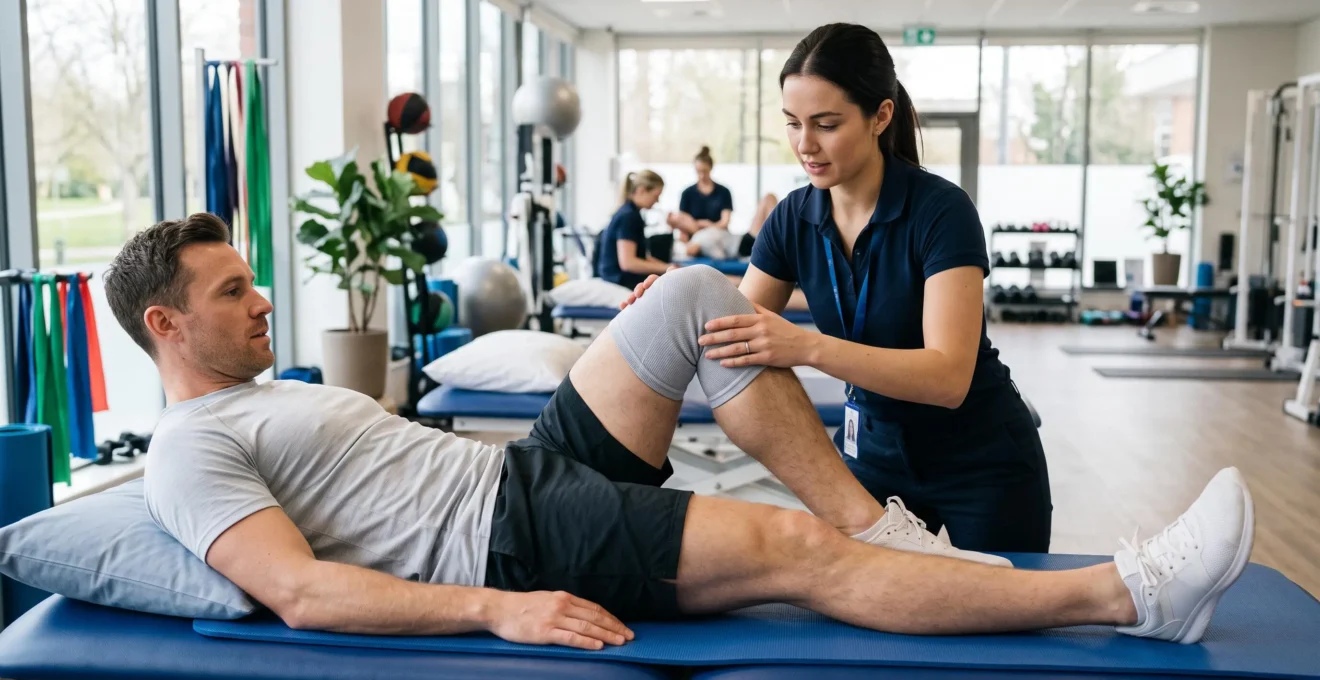
You had your knee operation in France and are now recovering at home, thousands of kilometres from the surgical team. The question that comes up every day is simple: am I on track? Without your surgeon down the hall, it can feel difficult to tell the difference between normal discomfort and a genuine warning sign.
The good news is that knee rehabilitation follows a predictable sequence of measurable milestones. Whether you had a total knee replacement, an ACL reconstruction, or a minor arthroscopy, your recovery unfolds across three broad phases — restoring mobility, rebuilding strength, and returning to full activity. Knowing what to expect at each stage gives you a reliable framework to evaluate your progress independently.
Three phases to track from home
- Phase 1 (weeks 1–6): pain control, regaining range of motion, walking short distances.
- Phase 2 (weeks 6–12): quadriceps strengthening, joint stability, longer walks without aids.
- Phase 3 (months 3–6+): return to daily activities and, progressively, to sport.
What are the key physical therapy milestones after knee surgery?
Recovery milestones are not vague goals — they are concrete, measurable checkpoints your physiotherapist uses to decide when you are ready to move to the next phase. In the first two to three weeks, the priority is controlling pain and swelling while gently restoring your knee’s range of motion. A useful early benchmark comes from the French Haute Autorité de Santé: before transitioning to outpatient rehabilitation after a total knee replacement, patients should achieve an active range of motion of at least 70 to 80°, walk a minimum of 30 metres, and report resting pain below 5 out of 10 on the visual analogue scale, according to HAS criteria for post-arthroplasty rehabilitation.
Between weeks four and eight, the focus shifts toward rebuilding quadriceps strength and improving balance. You should notice that stairs become easier and that you can stand from a chair without pushing off with your arms. By week twelve, most patients walk without a limp for moderate distances and begin light functional exercises.
Patients who underwent surgery with Pr. Etienne Cavaignac typically receive a structured follow-up pathway designed to keep these milestones on track even after returning to their home country. Maintaining that connection with the surgical team helps catch deviations early, when adjustments are still straightforward.
Keep in mind that these timeframes are guides, not guarantees. Individual progress depends on your age, pre-surgery fitness, the specific procedure, and how consistently you perform your home exercises. Falling a week or two behind a milestone does not automatically signal a problem — but consistently stalling for several weeks is worth discussing with a professional.
How do recovery milestones differ between knee replacement, ACL reconstruction and arthroscopy?
Assuming a single timeline fits every knee operation is one of the most common sources of patient anxiety. In reality, the milestones and their sequencing vary significantly depending on what was actually done inside the joint.
After a total knee arthroplasty, the early weeks centre on regaining full extension and reaching at least 90° of flexion so you can sit comfortably and climb stairs. A patient guide from the Centre Hospitalier de Versailles notes that driving is generally possible around six weeks post-surgery, while a return to low-impact sports such as swimming, cycling, golf, or walking is typically considered between three and six months, according to the CH Versailles total knee replacement rehabilitation guide. High-impact activities like running or singles tennis remain discouraged long-term.
After ACL reconstruction, the first priority is protecting the graft. Weight-bearing and range-of-motion milestones progress more cautiously during the first three months, and the emphasis is on neuromuscular control and hamstring-quadriceps balance rather than raw strength. Full return to pivoting sports usually requires nine to twelve months of structured rehabilitation.
Knee arthroscopy for a meniscal repair or cartilage debridement follows a shorter arc. Swelling control and full weight-bearing are often achieved within the first two to four weeks, and most patients resume normal daily activities within six to eight weeks. The milestones are less about rebuilding major muscle groups and more about restoring confidence in the joint during twisting and squatting movements.
| Milestone | Total knee replacement | ACL reconstruction | Arthroscopy |
|---|---|---|---|
| Walking without crutches | 3–6 weeks | 4–8 weeks (varies by graft) | 1–3 weeks |
| Driving | ~6 weeks | 6–8 weeks (left knee may differ) | 1–2 weeks |
| Return to low-impact sport | 3–6 months | 6–9 months | 6–8 weeks |
| Return to pivoting sport | Generally not advised | 9–12 months | 2–4 months if cleared |
These ranges reflect common clinical benchmarks. Your surgeon’s protocol may adjust them based on the specifics of your operation and your overall health.
Staying on track with your rehabilitation from anywhere in the world
Distance from your surgical team does not have to mean a loss of oversight. The key is replacing spontaneous in-person check-ins with deliberate, measurable self-monitoring and scheduled remote contact.
Start by defining three weekly self-checks you can perform at home without special equipment. First, measure your active knee flexion — the angle you can bend to while seated — and note any week-on-week change. Second, track your walking distance before pain or swelling forces you to stop. Third, monitor resting swelling by comparing the circumference of your operated knee to the other side. Writing these numbers down each week creates a simple progress log you can share with your surgeon or local physiotherapist during a video call.
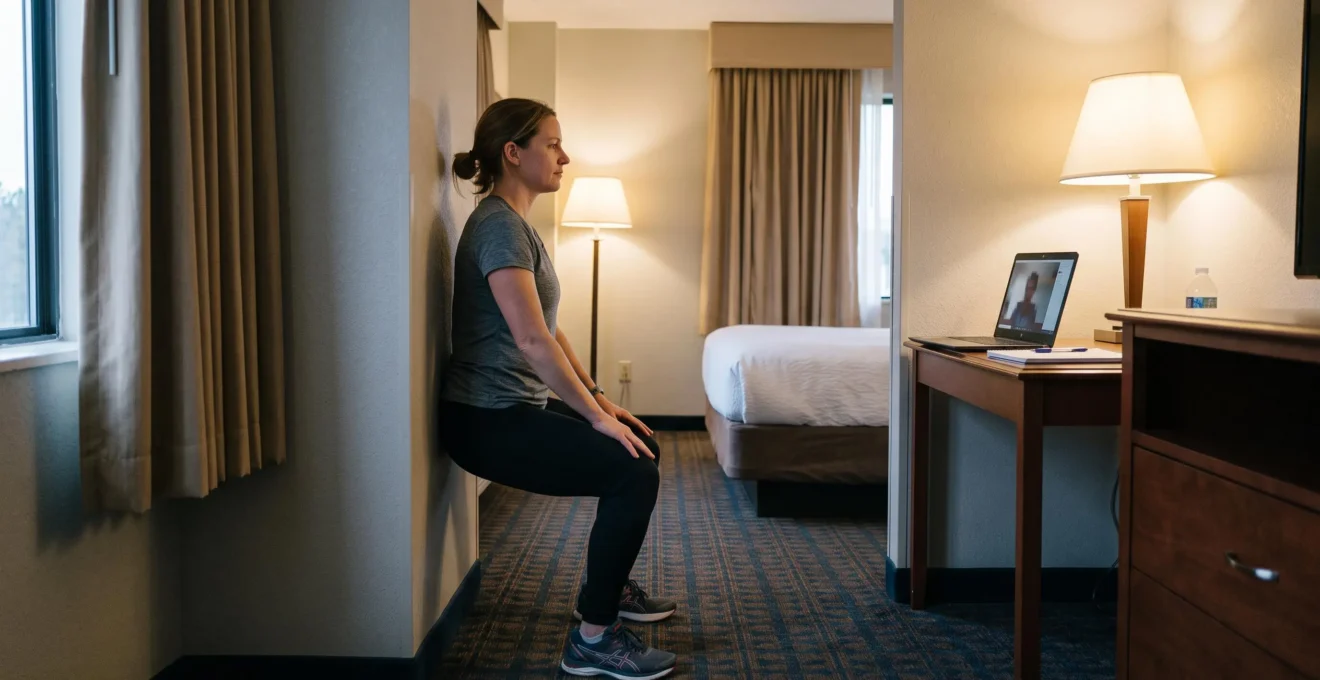
Digital follow-up platforms now allow surgical teams to monitor patient-reported outcomes remotely and flag deviations before they become setbacks. If your surgeon offers a structured digital pathway, use it consistently rather than only when something feels wrong. Scheduled check-ins at two, six, and twelve weeks post-surgery are a practical minimum.
There will be moments when remote guidance is not enough. If your knee locks, gives way repeatedly, or if swelling increases sharply despite rest and ice, seek an in-person evaluation from a local orthopaedic specialist or physiotherapist. Distance is manageable when progress is steady; it becomes a risk when warning signs are ignored.
Practical tips to make every physiotherapy session count
The quality of your rehabilitation depends less on the number of sessions you attend and more on what you do between them. A few practical habits can make a significant difference during the intermediate phase, when progress often feels slow.
Prepare before each session. Spend two minutes noting your pain level, stiffness, and any new symptoms since your last visit. This gives your physiotherapist accurate information to adjust exercises rather than spending the first ten minutes guessing.
Prioritise home exercise adherence. Research consistently shows that patients who complete their prescribed home programme daily progress faster than those who rely solely on supervised sessions. Even fifteen focused minutes twice a day yields better results than one long session every other day.
Manage flare-ups with ice and pacing. A temporary increase in swelling after a harder session is normal. Apply ice for fifteen to twenty minutes, elevate the leg, and reduce intensity the following day rather than stopping altogether. Complete rest during a flare-up often prolongs it.
Track small wins. The intermediate phase can feel frustrating because the dramatic early gains slow down. Keep a simple log of measurable improvements — five more degrees of flexion, an extra block of walking distance, one fewer painkiller per day. These incremental markers sustain motivation when the big milestones still feel far away.
Frequently asked questions about knee recovery milestones
How long does it take to regain full mobility after a knee replacement done abroad?
Most patients regain functional mobility for daily activities within three to six months after a total knee replacement. Full range of motion and strength may continue improving for up to twelve months. The location of your surgery does not change the biological healing timeline, but it does mean you need a clear remote follow-up plan with your surgical team and a local physiotherapist who can access your operative report.
What warning signs mean my knee rehabilitation is not on track?
According to the French Assurance Maladie guidance on post-knee-surgery warning signs, you should contact a doctor promptly if you experience a fever above 38 °C, increasing pain at rest, local heat or redness around the incision, wound healing problems, or a painful and swollen calf that could indicate a blood clot. These symptoms require medical evaluation regardless of where you are in your recovery timeline.
Does missing a single milestone mean something is wrong?
Not necessarily. Recovery is not linear, and a temporary plateau of one to two weeks is common, especially during the transition from phase one to phase two. What matters is the overall trend over several weeks. If a specific milestone remains unmet for more than three to four weeks beyond the expected window, discuss it with your physiotherapist or surgeon to rule out mechanical issues or adjust your programme.
How can I get medical input when my surgeon is in another country?
Start by scheduling regular video consultations with your surgical team at key milestone points — typically around two, six, and twelve weeks. Share your self-monitoring log and any photos of swelling or wound healing. For urgent or hands-on concerns, find a local orthopaedic physiotherapist and provide them with your operative report and discharge summary so they can align their treatment with your surgeon’s protocol.
Recovering from knee surgery abroad is entirely manageable when you know which milestones to watch and how to measure them. The three-phase framework — mobility, strength, return to activity — gives you a clear map, and consistent self-monitoring bridges the distance between you and your surgical team. Stay patient with the process, stay disciplined with your exercises, and do not hesitate to seek professional input when your progress log tells you something is off.
Medical disclaimer : This article provides general educational information about knee rehabilitation milestones and does not replace personalised medical advice. Always follow the specific post-operative protocol given by your surgeon and consult a qualified healthcare professional before making changes to your rehabilitation programme.